


In the world most of us live in, the prices of products and services cluster tightly around an industry average. That’s not an accident. It’s the natural outcome of competition, transparency, and the fact that most providers are drawing from the same cost structures and the same playbook. You can buy a haircut, a cup of coffee, a brake job, or a tax return in any city in America and the spread between “cheap,” “normal,” and “premium” is surprisingly narrow. Markets with lots of participants and lots of information tend to compress toward the mean. And the culture reinforces that clustering. We’re trained to believe that anything priced meaningfully below the average is probably a scam, a trap, or a product so defective it must be avoided. At the same time, anything priced far above the average gets framed as a luxury tier, a premium experience, or a high‑value upgrade that must justify its cost. So, what happens when you find something that is 75% cheaper than you expect?
As I was setting out on the project in Troy, I found that there are a number of programs and incentives that make it a no‑brainer to decarbonizing the building’s heating systems. In our case, using air‑source heat pumps (two‑way ACs) would allow the unlock of tens of thousands of dollars of incentives. So, to get a sense of what this part of the project cost, I followed the traditional path of seeking out a professional to help me price it out. Since we are doing 12 apartments and a store, I knew this bill would be anything but small. The two installers that I spoke with specified a traditional mini‑split system with a compressor unit somewhere outside and one or more indoor units to distribute the heat/cold. After good and insightful conversation, the bids came in at $160K and $155K, both sounded very reasonable. What I did not know at the time was the alternative I had.
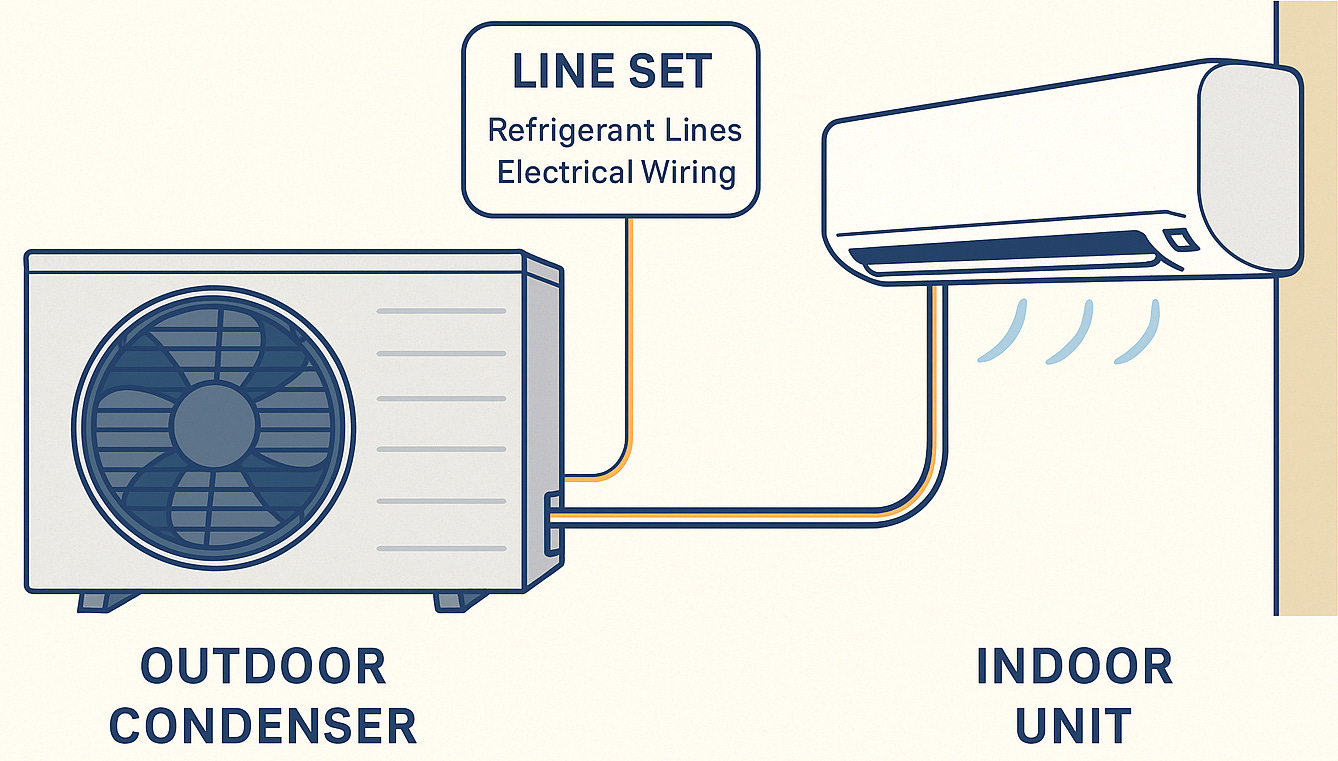
Installing compressors on rooftops and hanging off the side of a building requires both skilled installers and a good deal of electrical work to supply the units. But in the end, as an owner or tenant, I don’t care about any of that. All I want is reliable and inexpensive heating and cooling. So, when I came across a new class of product, the self‑installable window heat pumps, in a saddle form factor, I was immediately curious. These units do not require a professional installation. You hang the unit out the window, plug it in, and you are off to the races. Unlike window AC units, the window is still usable. Once I thought through this new form factor and its positive implications from an operating perspective, the next question was cost. In most situations ease of use and convenience drive a premium into a product’s price. But what about these?


I first saw these units at the New York Build Expo and was instantly impressed. At that time, I was not yet thinking we would need them for the Troy project, so I never asked about the cost. In one of those strange coincidences that are hard to explain, I saw a post on my LinkedIn feed from Gradient Comfort a couple of weeks ago from someone in my network. It was at that point that I realized that I knew the company CEO, small world. My curiosity was piqued about the price. So, I reached out to my local sales rep to get a price.
In my mind, I was anchored by the prices of the other bids. So, I was almost shocked when the price came in at $70K. Even better, with the decarbonization credits handled by the vendor, the price drops to $40K. At first, I was very doubtful, it seemed too good to be true. I could save over $100K and still install the newest heating and cooling technology? I dug into the product’s specifications, discussed how this product will be accepted by the local building code compliance, and looked into other field deployments of this tech. It didn’t take long. After a couple of hours, I knew this was both legit and disruptive.
I realized that when I first saw this technology it was presented as a solution to decarbonize large apartment buildings with old oil or gas boilers. In my mind I didn’t make the connection until months after I first saw this technology. The funny thing is, most of the breakthroughs that actually move your life or your business forward don’t come from grinding harder inside the same narrow lane. They come from bumping into something new, letting it bother you in a productive way, and then connecting it to something you already know.

The real engine of value creation is a mind that stays porous, curious, and willing to explore ideas that don’t have an obvious payoff yet. Creative thinking isn’t about being whimsical, it’s about building a bigger internal library so you can recognize patterns other people miss. The more inputs you expose yourself to, the more raw material you have for insight. And when you start stitching those inputs together, a detail from a building, a behavior from a landlord, a principle from a completely different domain, you unlock leverage that looks like intuition from the outside but is really just accumulated dots finally connecting.
At the end of the day, this is the same discipline great product managers use: ignore the noise, ignore the feature lists, ignore the shiny distractions, and anchor everything to the outcome the user actually cares about. In this case, it’s simple, reliable, and inexpensive heat and AC. That’s the “job to be done.” And once you frame it that way, the rest of the analysis snaps into place. You stop obsessing over form factors and marketing claims and start evaluating which solution consistently delivers the outcome with the least friction, the lowest lifetime cost, and the fewest surprises. Creative, curious, exploratory thinking isn’t abstract; it’s a practical tool for uncovering better paths to the same goal. When you stay focused on the outcome, you see value where others see novelty, and you avoid paying a premium for complexity that doesn’t move the needle.
Ready for more insights from the field? I’ve made the expensive mistakes, so you don’t have to. Subscribe to get weekly strategies, real numbers, and unfiltered lessons from 25+ years of actual deals. No theory, no fluff, just lessons learned and what actually works when your money is on the line.