


After demolition, our first major task in this project was replacing the roof. Not a simple tear‑off and re‑shingle job, but a full transformation from a tired flat roof into a clean A‑frame. The goal is to turn a cramped attic into a high‑ceiling living space with real views and real value. It is the kind of upgrade that intimidates most people, which is exactly why it is worth understanding. Projects like this look impossible from the outside, but once you break them down into research, planning, and careful execution, the path forward becomes surprisingly clear.
Let me put it this way: this project costs as much as a fully loaded Ford F‑150. While most people are confident that they can make the right decision with that kind of money simply by spending a couple of hours reading reviews and doing test drives, few would take on a construction project of the same size. In reality, both are $100K decisions. The difference is that the car decreases in price every day, while the house you improve will likely do the opposite. There is so much room for error in construction projects, but most people think it is the other way around. Losing money on a new car is a certainty. There is only some chance, which you can reduce through diligence, that project overruns will hit your wallet.

With that context in mind, let’s review how we got here and how we made sure that our research, careful planning, and attentive execution paid off.
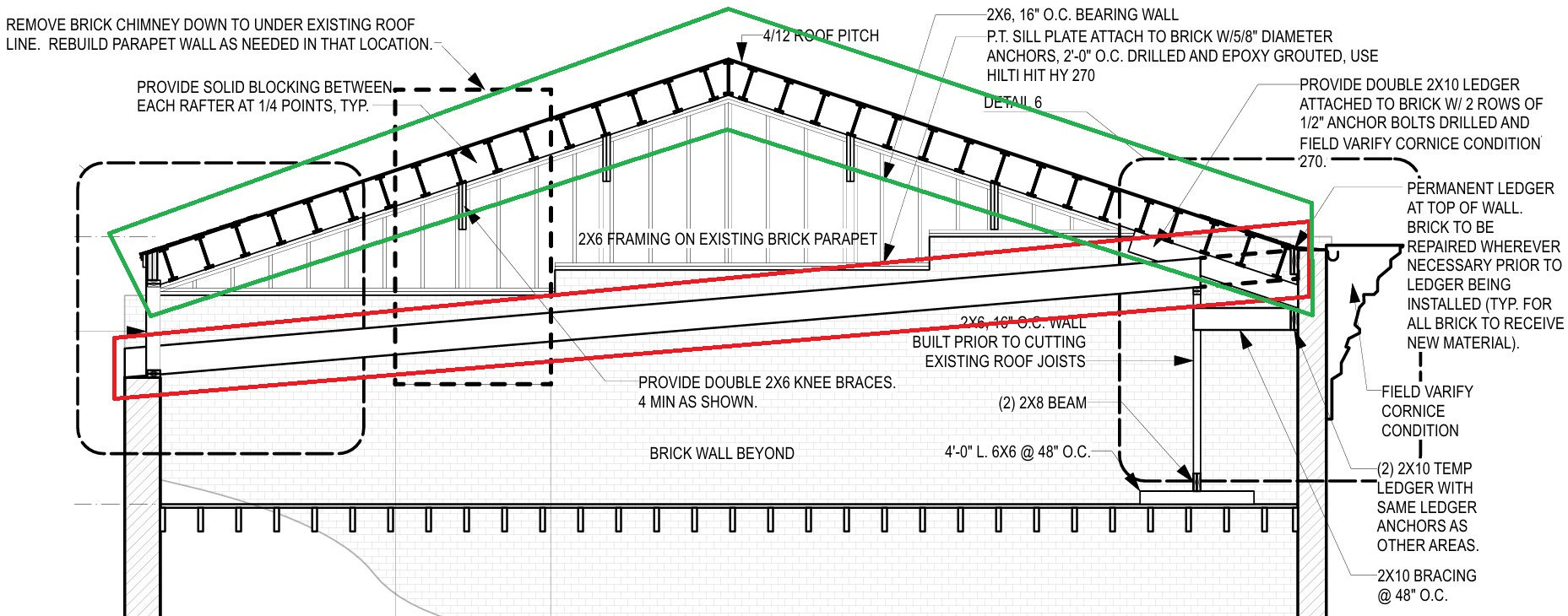
Like most parts of a real estate deal, the new roof addition started as a line item on a financial model. When it all started, we knew we had a very old building with a very old roof. In our model we accounted for the removal of the old roof, the abatement of the asbestos, and the replacement of the roof. Adding up the costs of simply fixing what was there, the numbers started to run up quite quickly, nearly $70K of spending without any significant impact on the revenue line. That is a painful expense. So, in trying to create a revenue offset to this expense, we came up with the idea of raising the roof to substantially increase the habitable area of the building.
In real estate there is a concept called “highest and best use.” In other words, what is the best structure that maximizes benefit while remaining legally and financially feasible. In our plan, one part of that strategy looks like the drawing below. I highlighted the old roof on the plans in red and the new roof in green.
Once we had drawings from the architect and engineer, we were ready to start executing on the new roof. We began by applying to the Troy Code Enforcement Office for a permit. As part of this process, environmental testing is required to make sure that no harmful material is released into the community as a result of the project. In our case, we knew we had asbestos since we did the testing shortly after acquiring the building. So our second step was to remove all the hazardous material we found.
As we covered in Oh Shit, Asbestos! What now?, we found a contractor and got all of the asbestos removed. What was left were century‑old wooden planks covered in tar on the carriage house, and the same on the main building but covered in a white plastic. While removing the asbestos, we found out that some of the black tar used to seal the roof also had to be removed. Since this tar was smeared on the roof and along the brick parapets, a significant portion from both structures had to be removed.


While the parapets were still standing, much of what we repaired could probably have been pushed off for a few years. But since we were already there doing the work, we chose to spend a little today to avoid massive repair bills in the coming years. We had to find a mason. The parapet along the neighboring building had to be extended, and the parapet on the other side had to be rebuilt. There were also a couple of old chimneys that needed to be taken down above the roofline and backfilled with new brick to reinforce the wall. In the end, the tops of all the walls will have been rebuilt, a new roof structure will be stronger, and the historic cornice has been refurbished for another hundred years of service.


At this point it may seem like adding this space will cost far more than it could ever return. If you only look at the roof and this one floor, that assessment would be correct. But here is the rub: this building had a very old roof that needed demolishing and remediation, the parapets were already worn out and needed rebuilding, and many of the existing roof joists had fire damage. These are all things we would have had to fix even if we did not increase the livable space. So, counterintuitively, spending significantly more money turned a liability into an asset. The new space will produce much more revenue than the bank will charge us in loan payments. A perfect opportunity for our strategy to generate marginal free cash flow.


A project like this rarely fits into a single chapter. The roof alone has enough moving parts, surprises, and judgment calls to justify its own series, which is exactly why we are taking it step by step. Each phase builds on the last. By slowing down and looking closely at what is happening behind the scenes, you start to understand how these decisions shape the long‑term health of a property.
If you are following along with your own project in mind, this is the moment to practice thinking like an investor instead of a spectator. Ask yourself what the work is really solving. Look at the structure, the materials, the timeline, and the tradeoffs. When you train yourself to see the underlying logic, you stop reacting to problems and start anticipating them. That shift is what separates a confident owner from someone who feels at the mercy of the building.
As we move into the next part of the series, keep one simple habit in mind. Before you touch anything, write down the outcome you want and the constraints you are working within. It sounds small, but it forces clarity. Clarity makes the next decision easier, and a string of easier decisions is how you finish a project that once felt too big to start.
Ready for more insights from the field? I’ve made the expensive mistakes so you don’t have to. Subscribe to get weekly strategies, real numbers, and unfiltered lessons from 25+ years of actual deals. No theory, no fluff, just lessons learned and what actually works when your money is on the line.