


We are almost two full years into our Troy historical district project, and the real work is just starting. Between delays in receiving architect drawings, the time it took to find a reliable contractor, the time required to get under contract, and the delays caused by the various rules of the City of Troy, the process has taken twice as long as I expected. I had figured on a year of getting through the paperwork and a year for construction.
You could say my estimate was optimistic, but I would argue that a year is a long time and there is no reason those same tasks could not have been accomplished within that time frame. In reality, it was probably two months of back-to-back work and ten months spent waiting in an invisible customer line that vendors pretended did not exist.
This short parable is a testament to the need for a careful and financially conservative approach. The lesson is simple: if I had started this project with a fixed pool of money to pay my bills, I would have run out of money. The reason the delay has not made a significant dent in the project scope is that I made sure my bills, while purchasing and holding this property vacant, were covered by recurring business income.
It should be your first rule in any project: make sure your income will be greater than your recurring bills when you take on something new. This is a strategy that anticipates delays and is designed to weather all economic conditions.
And so, weathering the storm, here we are at the shores of real construction. While we demolished the interior many months ago, much of the major demolition, including the carriage house, the terracotta extension, the decks, and the rear of the main building, remained ahead of us. Given the extent of the structures we are removing, we needed engineering plans to ensure we built the shoring correctly and to make sure the walls would not collapse.


The condition of the carriage house was terrible. The bricks near the roof were separating from the wall, creating a very dangerous situation. The rest of the wall was a hodgepodge of repairs and infill completed over the last century and a half. The old roof had already been removed during our “adventures in asbestosland.” It was time to take the structure down.
We decided to keep the side walls because their condition was sound, and there was no reason to risk disturbing the neighboring buildings, one of which is Troy City Hall. I know better than to poke the bear.
Taking apart the carriage house was no small feat. First, we needed to remove the roof and the front and rear walls of the second floor. Once we stripped off the subroof, we carefully removed all the loose bricks by hand. There were several areas on the back wall where water had leaked through the old roof. After a few years of freeze-thaw cycles, the face of the brick wall had deteriorated significantly.
The wall was in such poor condition that the crew simply used their hands to remove the bricks, brush off the layer of sand that had once been mortar, and then lift the brick from the course below. Unlike the front and rear walls, the side walls had been protected from the weather for the last century and a half.


In a building this old, you cannot simply start taking things down and assume everything else will cooperate with your plans. That is why we did not assume the side walls would remain standing on their own after the front and rear walls were removed. We are very confident that they will stay up, but we cannot gamble with the safety of the crew.
To provide an additional margin of safety, we installed lateral shoring between the two walls. This way, nothing would collapse by accident. Four horizontal supports were installed approximately twenty feet above the ground in preparation for removing the front and rear walls.
Next, we removed the old terracotta-block extension and the decks. I often wondered what people did in these spaces during the many years the storefront served members of the community. My best guess is that the terracotta extension was added when the luncheonette first opened in 1949 and was used as the kitchen and restroom area while patrons were seated in the front dining space.
As for the decks and stairs, their primary purpose was to satisfy fire-escape code requirements. My best guess is that the carriage house was used to house a separate business, Family Gardens Grocers. It appears that both businesses operated and advertised from this location throughout the 1940s and 1950s.


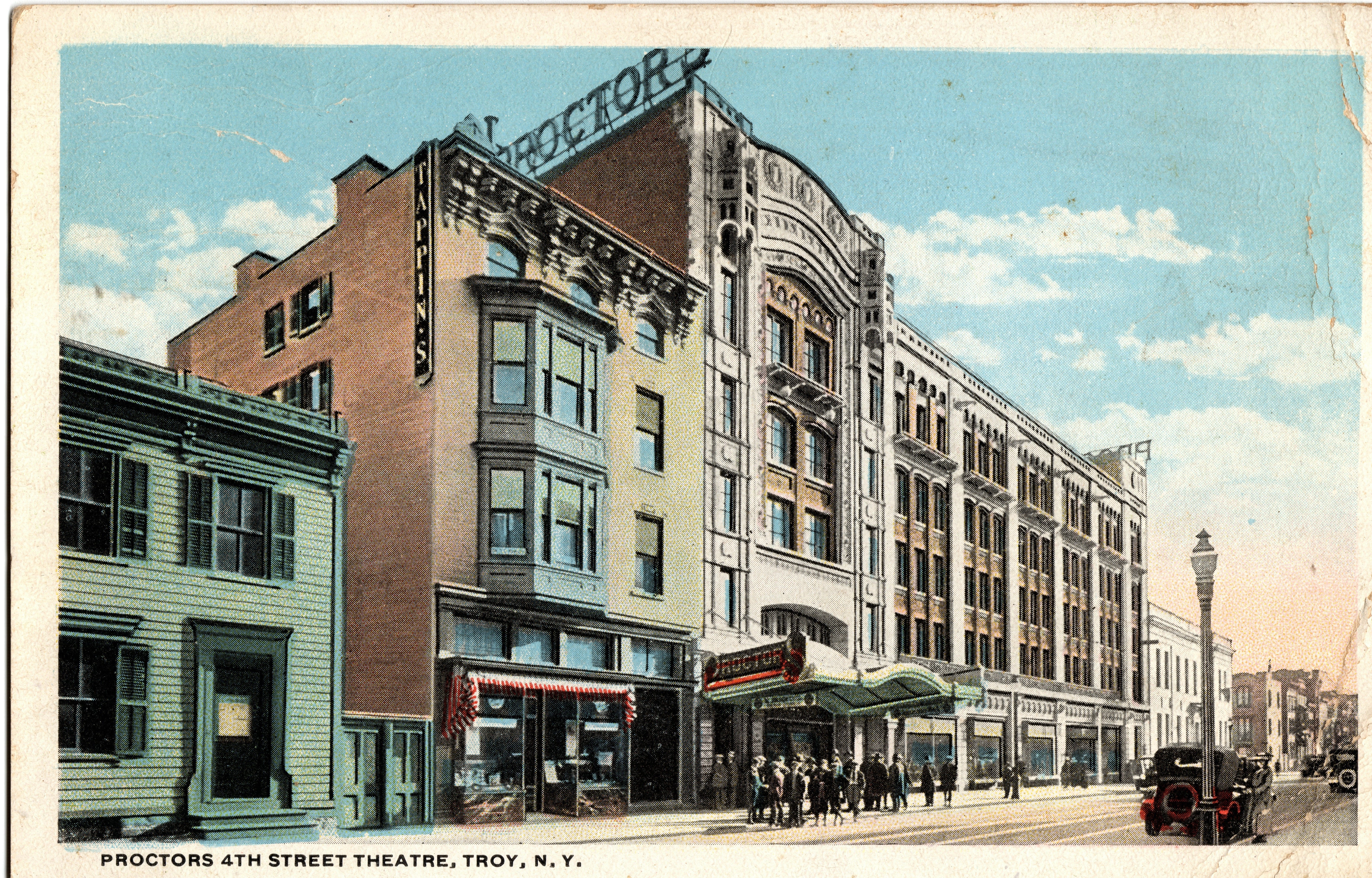
The earliest record I could find of the building’s commercial use was a postcard from 1918 showing Tappin’s, a jewelry store. The next businesses I found were Charlie’s Candies, Proctor’s Luncheonette, Proctor Sweet Shop, Family Gardens Grocers, an optical store, and two hair salons. I spent some time reviewing historical newspaper archives and found several interesting advertisements.
All in all, we are filling dumpster after dumpster and will spend more than $200,000 removing old brick, plaster, framing, roofing, and concrete. Why? Because, as they say in real estate, “Location, location, location.”
Being located in the heart of a walkable, historic Gilded Age city filled with cafes, galleries, and restaurants is something many people are willing to pay a premium for. As the building’s vibrant commercial history demonstrates, if the City of Troy is healthy and downtown is thriving, there are many reasons to be there and many reasons to call it home.


That is the thing about real estate. People often focus on the finished product and forget the process that creates it. They see a new apartment, a busy storefront, a renovated façade, or a crowded sidewalk café and assume the outcome was inevitable. As if all someone had to do was write a check and wait patiently for progress to arrive.
Nothing could be further from the truth.
Every project is really a story about uncertainty. Nobody knows exactly what construction costs will be two years from now. Nobody knows what interest rates will be. Nobody knows whether tenants will lease as quickly as projected or whether some forgotten structural issue will appear the moment a wall is opened. The investor is making a prediction about the future, and then spending years discovering how wrong that prediction was.
The reason I am willing to spend more than two hundred thousand dollars demolishing large parts of this building is because I am not really investing in the bricks. I am investing in the location. The demolition work, the engineering plans, the permits, the financing, and the construction are all just tools used to unlock the value that already exists here. The value comes from being in downtown Troy. The value comes from being surrounded by people, businesses, restaurants, parks, events, and all the other ingredients that make cities interesting places to live.
That perspective helps explain why I am so optimistic about downtown Troy over the long term. The individual businesses will continue to change. Some will thrive. Some will fail. New ideas will replace old ones. That process has been repeating itself for well over a hundred years. What matters is that there are enough people living, working, and spending time downtown to support that constant cycle of renewal.
When you walk through a city like Troy, it is easy to focus on what is broken. The vacant storefront. The deteriorated building. The road that needs repair. Those things are visible. What is harder to see are the incentives quietly pulling everything in the opposite direction. Every investor buying a building. Every entrepreneur opening a business. Every resident signing a lease. Every contractor rehabbing another apartment. All of those individual decisions add up.
In many ways, development is simply an act of optimism. Nobody would spend years of their life and millions of dollars trying to improve a property if they believed the future would be worse than the present. Every renovation is a bet that the neighborhood will be a little better tomorrow than it is today. Every restored building is a vote of confidence in the community surrounding it.
Demolition is one of the most satisfying parts of redevelopment. Before you can build something better, you first have to let go of what no longer works.
And so, after two years of planning, waiting, negotiating, designing, reviewing, permitting, financing, and preparing, we are finally arriving at the part most people think of when they hear the word construction.
Ready for more insights from the field? I’ve made the expensive mistakes, so you don’t have to. Subscribe to get weekly strategies, real numbers, and unfiltered lessons from 25+ years of actual deals. No theory, no fluff, just lessons learned and what actually works when your money is on the line.