


When I first heard the words “tax abatement,” I immediately assumed somebody is getting a special favor. Do you make that same assumption? It’s an understandable reaction. If you explain an IDA (Industrial Development Agency) PILOT (Payment In Lieu of Taxes) program in a single sentence, it sounds exactly like that. A developer asks for lower taxes and the government says yes. That the one-sentence explanation completely misses why these programs exist. The reality is much more complicated. In the case of our project in downtown Troy, tax abatement is the difference between a completed project and another generation of vacancy.
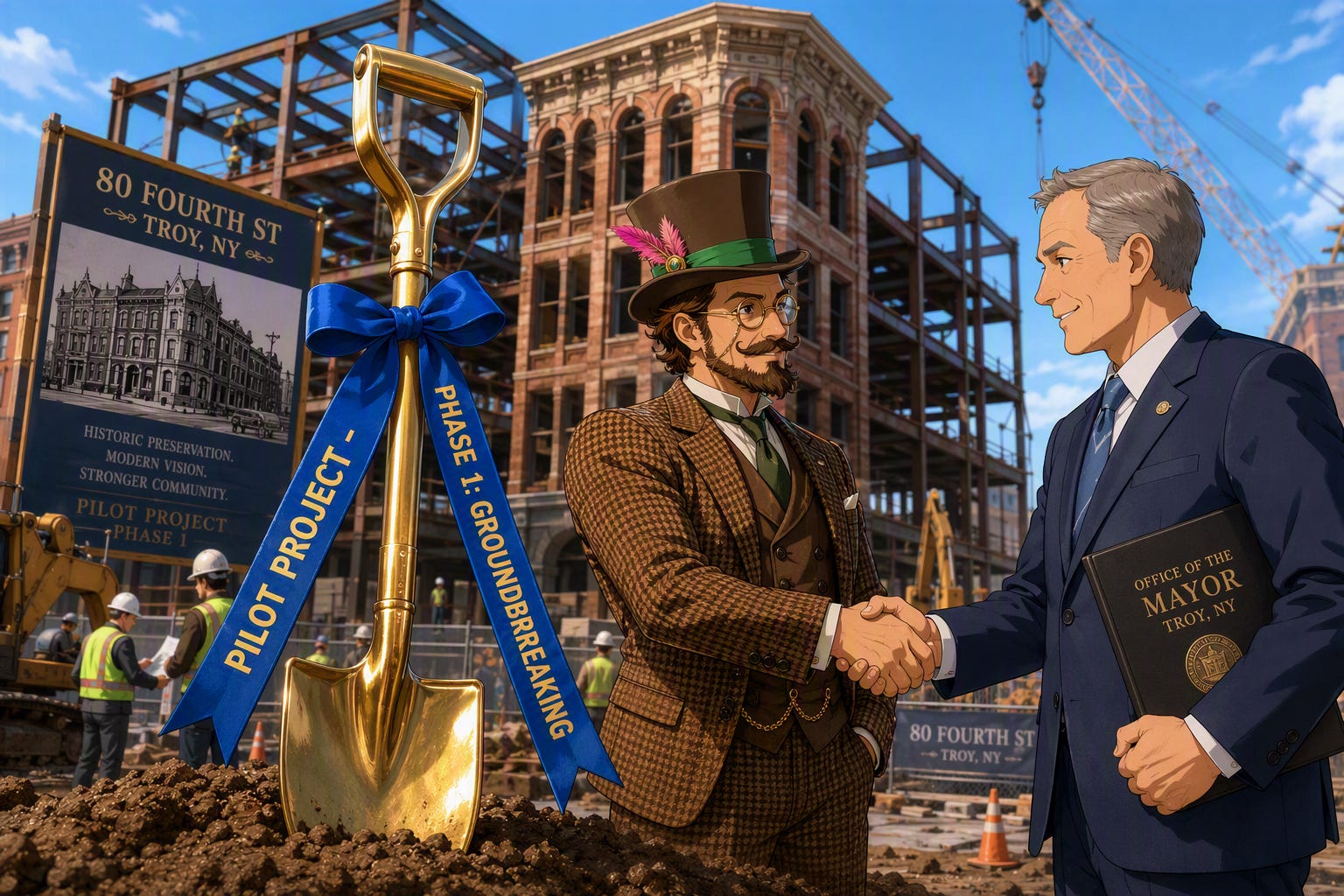
When we purchased the building in Troy, we weren’t buying a functioning apartment building. We were buying a “value add opportunity” (a shit-hole fixer upper). The storefront had been vacant for nearly thirty years, much of the building had suffered deferred maintenance, and the rear carriage house sat largely vacant, neglected, and near collapse. The project required a complete gut rehabilitation, structural stabilization, environmental remediation, extensive architectural work, and the construction of approximately 3,000 square feet of building additions. The goal was to transform a building containing three apartments and a storefront into a mixed-use property with twelve workforce housing units and a commercial space.
Like many historic buildings in downtown Troy, the challenge wasn’t whether the project would be valuable after it was completed. The challenge was surviving the journey between those two points. The dirty secret of historic redevelopment is that the finished building is often worth less than the amount of money required to create it. That statement confuses people because it sounds backwards. If a project costs three million dollars to complete, shouldn’t it be worth at least three million dollars? Not necessarily.
Real estate values are determined primarily by income. Construction costs are determined by labor, materials, regulations, insurance, and hundreds of other inputs that have very little relationship with income. When construction costs rise faster than rents, a gap appears. The entire purpose of economic development incentives is to close that gap. That is where the Industrial Development Agency enters the story. The Rensselaer County IDA was created, like most IDAs, to solve a problem that cities have struggled with for many decades. Cities need private investment. Investors need acceptable returns. Sometimes those two objectives align naturally. Sometimes they do not.
Nobody needs an incentive to build luxury apartments on Fifth Avenue in New York City. The market already provides enough motivation. But what happens when a building has been partially vacant for decades? What happens when rehabilitation costs far exceed what a lender considers normal? What happens when a project creates public benefits but struggles to support private financing? Those are the projects the IDA was designed for.
The mechanism most people know is the PILOT program. PILOT stands for Payment In Lieu Of Taxes. Contrary to popular belief, the building does not stop paying taxes. Instead, the property follows a predetermined tax schedule that gradually increases over time. The goal is simple. During the years immediately following redevelopment, when debt burdens are highest and risk is greatest, the project receives temporary relief. As the project stabilizes, taxes step up toward their full amount.
The concept is surprisingly politically sensible. Imagine a building generating taxes based on a neglected property worth five hundred thousand dollars. The owner invests millions into rehabilitation. The assessment immediately increases to reflect the new value. That sounds reasonable until you realize that the owner now needs to service construction debt, lease vacant units, stabilize operations, absorb cost overruns, and simultaneously pay taxes on value that has not yet translated into cash flow. The PILOT smooths that transition.
For our Troy Project, that matters enormously. By the time we submitted our application to the Rensselaer County Industrial Development Agency, we had already invested approximately $1 million into the project. Roughly half represented acquisition costs and another half represented architectural work, asbestos remediation, structural stabilization, utilities, and municipal approvals.


This is another part of development that often gets overlooked. People imagine developers buying properties and immediately making money. In reality, there are usually years of risk before there is any income. At the Fourth Street project, we had already spent significant money solving dangerous conditions, stabilizing the structure, repairing the roof, completing environmental work, and moving the project through design and approval.
The PILOT does not and will not eliminate that risk. It simply acknowledges its existence. The public benefits are equally important. The project transforms a property with three residential units and one chronically vacant storefront into twelve workforce housing units and a commercial space, which is already leased to a local cafe.
The storefront alone tells an interesting story. The commercial space had been vacant for nearly thirty years. The redevelopment supports bringing a local café back to the building and adds another active business to downtown Troy. A vacant storefront contributes almost nothing to a neighborhood. A functioning business creates jobs, pedestrian activity, sales tax revenue, supplier relationships, and economic momentum that spills into neighboring properties.
The housing component matters just as much. Troy, like many cities, faces increasing pressure on housing supply. Creating nine additional apartments within an existing downtown building does not solve the housing shortage. It does, however, move the city in the right direction.
Economic development rarely happens through a single massive project. It happens one building at a time. Another interesting aspect of our project is where the building is located. The project sits in Census Tract 407, an area identified as having a poverty rate exceeding 20 percent; the unemployment metrics that qualify the area as highly distressed under applicable economic development criteria. This context is important.
The purpose of the program is not merely to help developers. The purpose is to encourage investment in places where investment is needed most. If private capital naturally flowed into every distressed neighborhood, there would be no reason for an IDA. The program exists precisely because market forces alone often fail to produce redevelopment in these locations.
I was recently asked what the PILOT is worth. The honest answer is that it depends on assessments, municipal rates, the final structure approved by the IDA, and numerous future variables. Without a finalized PILOT agreement, any estimate is only that, an estimate. What I can say is that for a multi-million-dollar historic redevelopment, the value is often measured in hundreds of thousands of dollars over the life of the program rather than tens of thousands. More importantly, the benefit arrives during the years when it is most needed. The timing is often more valuable than the total amount.
That is another lesson real estate teaches repeatedly. Timing matters. A dollar received when a project is struggling can be worth far more than a dollar received when the project is fully stabilized. The application process itself is surprisingly straightforward, although not necessarily simple. The developer submits a detailed application describing ownership, project scope, construction plans, employment impacts, public benefits, tenant information, environmental review materials, and economic justification. The application is reviewed by the agency, subjected to environmental review, considered at public meetings, and ultimately evaluated through a public hearing process before final approval. The agency also requires fees, supporting documentation, and reimbursement of associated review costs. In other words, it is not free money.Nor should it be.The public deserves transparency whenever public incentives are involved.
That requirement for accountability is one of the things I actually appreciate about the process. At the end of the day, the PILOT program is not really a tax reduction program. It is a risk-sharing program. The developer assumes construction risk, financing risk, leasing risk, environmental risk, and market risk. The community temporarily reduces part of the tax burden in exchange for new housing, new businesses, construction activity, job creation, and a revitalized property. Both sides are investing.Both sides are taking a bet.
For the Troy project that bet means transforming a partially vacant historic building into twelve workforce housing units and a new commercial space in the heart of downtown Troy. Whether viewed through the lens of housing, economic development, historic preservation, or tax policy, that seems like the kind of deal these programs were created to support.
Ready for more insights from the field? I’ve made the expensive mistakes, so you don’t have to. Subscribe to get weekly strategies, real numbers, and unfiltered lessons from 25+ years of actual deals. No theory, no fluff, just lessons learned and what actually works when your money is on the line.