


On a quiet street in Brooklyn, a friend of mine who had purchased an apartment building the year before thought he had everything under control. His spreadsheet showed a tidy 5 percent vacancy reserve, enough, he believed, to cover the occasional month without rent. Then his tenant lost her job and stopped paying. What followed was six months of missed income, a drawn-out eviction process, and several thousand dollars in legal fees. By the time a new tenant moved in, nearly half a year of revenue had evaporated. The neat 5 percent placeholder in his pre purchase financial model had masked a brutal reality: risk is not an average; it is a distribution. In real life, sometimes the statistical tail wags hardest.
I never had much interest in finance or banking when I was younger. I naively thought those businesses were all about money, when in reality I had it backwards. As I learned more about the role of banking and finance, I began to realize that the old adage “It is about return of capital, not just return on capital” is at the heart of everything. The most important part of investing is getting your money back. The second most important part is getting back more. Lending money at 20 percent interest might sound like a great investment, but it is a terrible one if the borrowers fail to pay you back. The key word in that sentence is “if.” Why is “if” so important? Because it is the only word that really matters. Whenever you hand someone money, whether a bank or a store clerk, there is always a chance that what you get back is far from what you expected. That is risk.

You may buy an item and discover you were cheated, or deposit cash at a bank that later goes bankrupt. No matter how small the chance, there is always a chance. Risk is never zero. Combine this idea with the notion that investors always want their money back as a bare minimum outcome, and it becomes clear that most investing is about managing risk, not managing money. For me, this realization was an epiphany. It reframed my entire understanding of investment strategy. Risk is the great equalizer. It is the lens through which we compare options for deploying capital. Your cousin’s new restaurant may promise 25 percent annual returns, but one in three restaurants fail within two years. That means there is a one third chance you will get nothing back and two thirds chance you will earn 25 percent. The opportunity matters, but the chance of losing everything matters more.
Things rarely turn out exactly as planned, which is why thinking in terms of risk is a critical perspective. Everything carries some level of risk, even depositing cash at the bank. There is a tiny chance the bank will fail and an even tinier chance the FDIC will not pay out deposit insurance. The probability is incredibly low, but risk is never zero.
In real estate, most investors use financial models that account for risk, but those models rarely show or explain it. A simple example is the vacancy reserve. Look closely at any residential property financial model and you will see a line item for vacancy, often set at 5 percent. It is a convenient placeholder, but not a true indicator of risk. The reality looks more like this: when an apartment becomes vacant, you can expect to lose at least one month of rent. You might be lucky and re lease immediately, or unlucky in a weak market and sit vacant for several months. The 5 percent rule of thumb is just an average. Reserving for it does not mean you are free from risk. Real risk is about preparing for the worst-case scenario, not the average bad day at the office.
Here are four ways to break down the outcome of a vacancy and a probability of each:
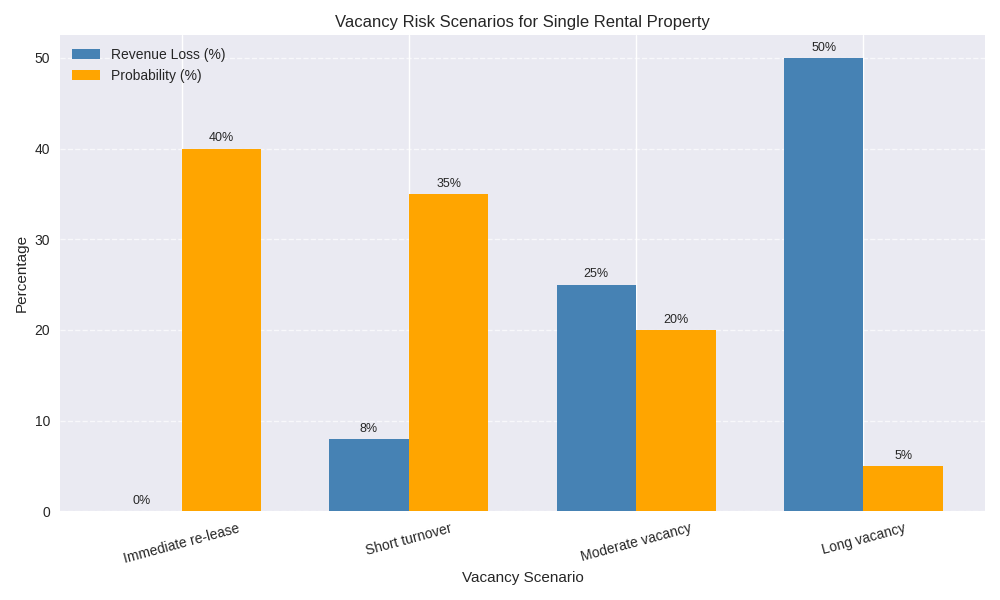
If you own a single rental house and your tenant loses their job, you will lose 8 percent of annual revenue each month until the unit is re-leased. The real risk is not the average 5 percent, it is the possibility of losing far more. That does not mean you need to be ready for the worst case on day one. It means you need to build resilience to low probability events. In tactical terms, the vacancy reserve is money you must save to build a proper operating capital reserve. The real risk is not having enough saved when the unexpected happens.
Thinking in terms of risk is a critical skill because it forces you to work through scenarios. If you think through possible outcomes, you can plan for what happens in both best case and worst-case situations. You need to know if there is a scenario that could ruin your business and the probability that it may happen. It does not matter how profitable a property could be if a catastrophic event leaves you unable to collect rent and facing foreclosure. Remember: “It is about return of capital, not just return on capital.” The scenarios you must avoid are the ones that put you out of business. If you fail to identify them, you will only realize you are in trouble once you are already neck deep in it.
When you face uncertainty, apply scenario-based thinking. Work through these steps:
Define the problem you need to resolve
Identify the key uncertainties you face
Decide how many scenario outcomes reflect reality
Define scenario outcomes and forecast their probabilities
Test your readiness to survive each scenario
If you have the misfortune of non-paying tenants who only leave by eviction, are you prepared to lose three to six months of rent plus thousands in legal fees? Can you absorb that loss, or would it be catastrophic? While unlikely if you screen tenants properly, it is not impossible. To be resilient, you need a plan to survive. Over time you can build reserves and resilience, but as you start and grow your business you must take calculated risks. If you never buy a lottery ticket you never lose, but you also never win.
In the end, successful investing is not about predicting a single outcome but about preparing for a range of possibilities. Just as a chess master studies the board and looks several moves ahead, weighing the probability of each response from an opponent, an investor must think through scenarios and their likelihoods. The strength of a chess player lies not in assuming the opponent will make the obvious move but in preparing for the unexpected one that could change the game. In the same way, the strength of an investor lies in anticipating both the best and the worst cases and building a strategy that can withstand them. Success comes not from certainty but from resilience, from the ability to survive the most dangerous moves while being ready to seize opportunity when the board opens in your favor.
Ready for more insights from the field? I’ve made the expensive mistakes so you don’t have to. Subscribe to get weekly strategies, real numbers, and unfiltered lessons from 25+ years of actual deals. No theory, no fluff, just lessons learned and what actually works when your money is on the line.